
News |
PRESS CONTACT: Linda Chanow Phone: (703) 786-9280 Email: Linda.Chanow@TheIILP.com or Info@TheIILP.com Call for Papers Get published in the Review that busy lawyers, judges, bar leaders, and diversity professionals rely on for the latest DEI initiatives and research!
The Institute for Inclusion in the Legal Profession (IILP) is seeking submissions for the 2025 edition of the IILP Review: The State of Diversity and Inclusion in the Legal Profession.
The goal of the Review is to provide up-to-date, comprehensive coverage of diversity and inclusion issues, research, and strategic initiatives, in an easily accessible format for the benefit of busy practicing lawyers, judges, law students and other professionals.
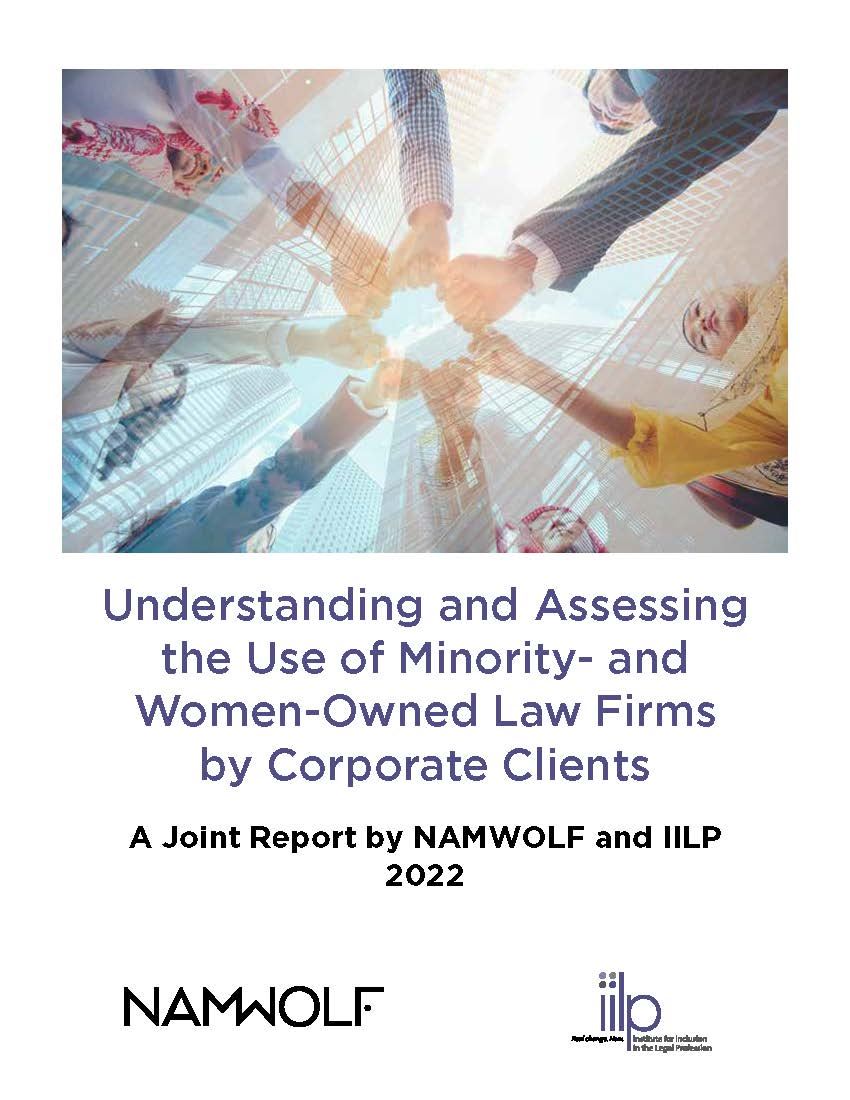
The Review will be distributed to attendees at the IILP’s annual State of Diversity and Inclusion in the Legal Profession Symposia, which will be held in six to eight cities around the country. Selected authors may be invited to present their papers at one or more Symposia. The Review also will be distributed to the General Counsel of the Fortune 500, the heads of the AmLaw 200 law firms, bar association leaders, law school libraries and placement offices, and made available for downloading at no cost from the IILP website. SEC Chair Gensler and Leaders from FINRA, Nasdaq, and Cboe to Join IILP for Unprecedented Look at DEI in the Financial Services Industry September 14, 2022 – Leaders from three of the major self-regulatory organizations in financial services—FINRA, Cboe, and Nasdaq—will participate in a virtual panel discussion to explore how their recent diversity, equity, and inclusion regulations are influencing the companies they regulate, the DEI efforts of those companies’ law departments, and the law firms they hire. “The financial services industry is among the most influential in the world. Greater diversity, equity, and inclusion in this particular industry stands to create a powerful ripple effect within the legal profession. These three SROs have been in the forefront of emphasizing DEI to the companies they regulate,” said Sandra Yamate, CEO of the Institute for Inclusion in the Legal Profession (“IILP”). The program, “From Financial Services Green to DEI Gold,” which is organized by IILP, will open with remarks by U.S. Securities and Exchange Commission Chair Gary Gensler followed by the panel discussion featuring Robert W. Cook, President and CEO, Financial Industry Regulatory Authority (“FINRA”); Edward Knight, Executive Vice Chairman, Nasdaq; and Catherine Clay, Executive Vice President, Cboe. The panel will be moderated by Christopher Lewis, General Counsel, Edward Jones. It will take place on September 15, 2022, from 2:00 – 4:00 PM EDT. “Too often, when the legal profession thinks about DEI efforts, the focus is solely on the relationship between the client and the lawyer. We forget that we operate within a complex environment of relationships, interactions, pressures, and motivations,” explained IILP Chair Bruce Byrd. This program is a rare consideration of what might be motivating clients, who in turn, will be seeking greater DEI efforts from in-house and outside counsel.” In conjunction with the program, IILP will also be releasing a new publication, From Financial Services Green to DEI Gold, featuring thought leadership articles about DEI in the financial services industry. IILP and NAMWOLF RELEASE JOINT REPORT August 24, 2022 — The National Association of Minority and Women Owned Law Firms (NAMWOLF) and the Institute for Inclusion in the Legal Profession (IILP) are proud to present “Understanding and Assessing the Use of Minority- and Women-Owned Law Firms by Corporate Clients.” The joint report summarizes the findings of a study begun more than three years ago, assessing the use of diverse-owned firms by corporate clients. “With this study, for the first time, corporate clients can see how they and others are determining when to use diverse-owned firms and the kinds of work they are assigning. The report provides lawyers and diverse-owned firms with a clearer picture of what corporate counsel are looking for, and value, from their outside counsel. It also highlights how clients may be overlooking additional options when seeking to advance diversity in the profession,” said IILP CEO Sandra Yamate. In 2001, NAMWOLF was established to promote the success of its member firms by effectively vetting them through application of stringent membership criteria intended, among other things, to reassure corporate clients about these firms’ genuine minority- or woman-owned status, their stability, and their ability to bring to bear the necessary resources and skill sets to be able to handle the legal work of major corporate clients without sacrificing the quality corporate clients rightfully demand. Today, minority- and women-owned law firms are an established and respected part of the landscape of law firms available to corporate clients. “Women- and minority-owned firms have been a great place for women and minorities to practice law at the highest levels while providing unique value to corporations without some of the frustrations of large law firms,” said NAMWOLF CEO Leslie D. Davis. “The long-term viability of law firms owned by women, minorities, openly LGBT people, and people with disabilities will depend on corporate clients’ continued assignment of work to them. It is the hope of NAMWOLF and IILP that this report will play a part in that long-term project.” IILP'S NEW REPORT GARNERS PRESS ATTENTION Michele Gorman and Sue Reisinger, "Diversity is 'Doomed' Unless GCs Step Up, Report Suggests," Law360, August 3, 2022. Sue Reisinger, "What's Really Behind the Lack of Diversity at Law Firms," Law360, August 1, 2022. Phillip Bantz, "Companies Still Aren't Sending Enough Work to Diverse Outside Lawyers, Report Says," Corporate Counsel, July 29, 2022. IILP TO RELEASE FIRST HARD DATA ON CORPORATE DIVERSITY SPEND July 27, 2022 – A new report by the Institute for Inclusion in the Legal Profession (“IILP”) finds that despite the attention the legal profession pays to the business case for diversity, corporate clients are not directing much of their outside counsel spend to lawyers who are women, racial/ethnic minorities, LGBTQ+, or have disabilities. “As a profession we’ve been talking about the business case for diversity for over 30 years. Now, for the first time, we have hard data examining what that corporate diversity spend actually looks like,” said Sandra Yamate, CEO of IILP. 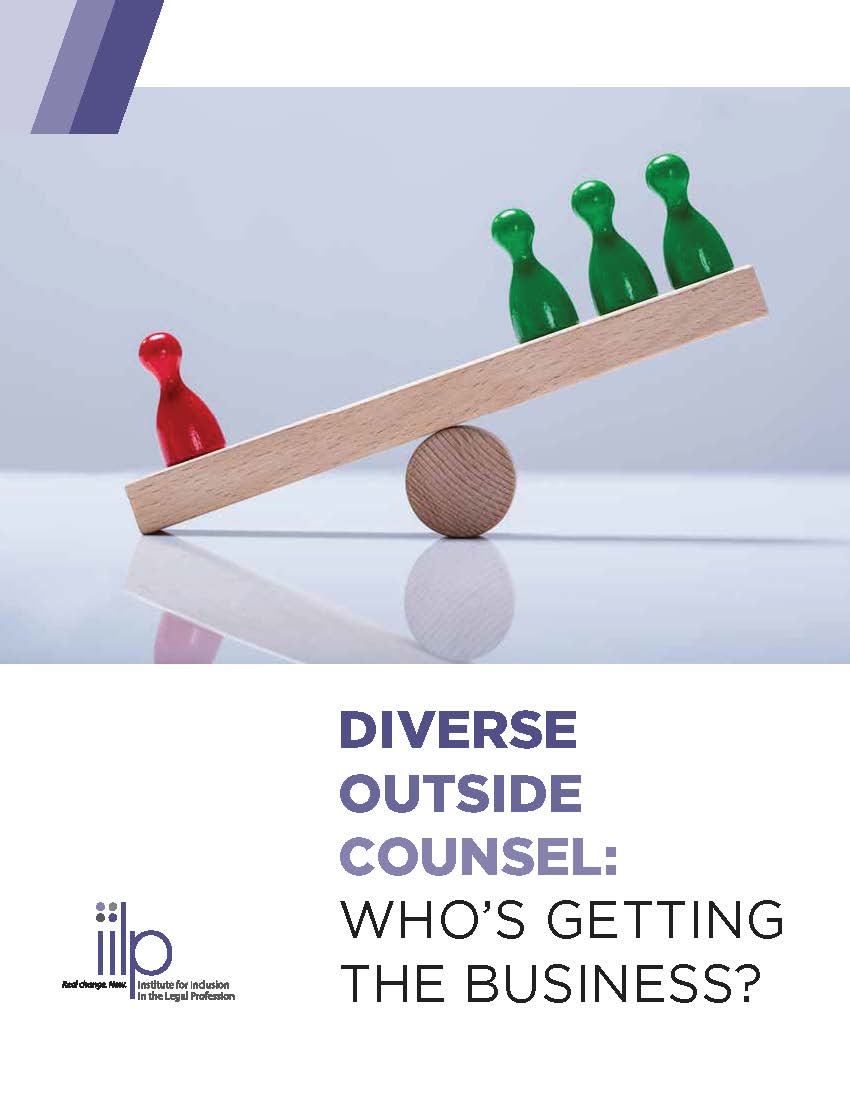
In “Diverse Outside Counsel: Who’s Getting the Business,” IILP found that most corporate clients give less than 10% of their business to lawyers who are diverse. White women lawyers receive significantly more of that business than lawyers who are racial/ethnic minorities. It was less clear as to how lawyers who are LGBTQ+ are faring due to the number of corporate clients who do not collect data on LGBTQ+ lawyers. Lawyers with disabilities were the group least likely to receive business from corporate clients. These and related findings were collected through an online survey of corporate clients. Over half the 136 corporations that responded identified themselves as part of the Fortune 500. IILP examined whether corporate clients are tracking the diversity of their outside counsel and the types of diversity being tracked. Few are tracking religious diversity despite societal concerns about Islamophobia, but more are beginning to disaggregate the data they collect about the racial/ethnic diversity of their outside counsel. IILP also examined what corporate clients are doing with the data once they collect it. Almost two-thirds said that they discuss the data with their outside counsel. A resounding 82.5% have not set any diversity goals for their outside counsel. Corporate clients are also focusing greater efforts on encouraging and supporting their “go-to” outside counsel firms’ diversity efforts. There is an emphasis on more “carrots” and fewer “sticks.” “This research is the next step forward in elevating the legal profession’s DEI efforts,” explained Bruce R. Byrd, IILP’s Chair and Executive Vice President and General Counsel of Palo Alto Networks. “It’s not enough to simply tell outside counsel law firms to become more diverse. We trust that this research will assist corporate clients seeking to expand the amount of business they direct to diverse lawyers.” Madeleine McDonough, Chair of Shook, Hardy & Bacon LLP added, “Many corporate clients are devoting significant resources to support the increased diversity within their outside counsel law firms. This research is a reminder that diverse talent already exists in many of these firms.” IILP will reveal the findings of the study on August 2 at A Virtual Summit on IILP's New Report, "Diverse Outside Counsel: Who's Getting the Business?". The report will be available for download at www.TheIILP.com following the event. |
|
Let's Create An Ethical Obligation For Attys To Fight Racism Previously published by By Marc Firestone and David Douglass The protests and demonstrations arising from the murder of George Floyd and so many others — Ahmaud Arbery, Breonna Taylor and Rayshard Brooks, in just recent weeks — opened the world's eyes to the extent of systemic racism here in the U.S. and beyond. All of us in the legal profession — a profession uniquely positioned to advance equal justice for all — should find it is unconscionable that society permits racism and its accompanying inequities to continue to plague our country as virulently as COVID-19. Yet, despite our roles as practitioners, judges, legislators, and civic and community leaders, the legal profession is hardly immune to systemic and institutional racism. In fact, it remains one of the least diverse professions[1] in the U.S. It is therefore vital that the profession work both to dismantle systemic racism and to promote diverse, inclusive institutions — beginning from within. Those propositions are, unfortunately, hardly new. In 2012, the Institute for Inclusion in the Legal Profession, or IILP, a nonprofit that aims to advance diversity in all its facets throughout the legal profession, proposed the addition of a diversity/inclusion rule to the American Bar Association. The IILP proposed that "there be a new section that would specifically make efforts to increase diversity and inclusion in the legal profession a matter of ethics and professional conduct" and, consistent with the preamble to the ABA Model Rules of Professional Conduct, requested it be adopted and made a permanent part of those model rules.[2] At that time, the ABA rejected this call, concluding, "Model Rule 8.4 Comment [3] already clarifies 'that any conduct that manifests by words or conduct bias or prejudice is prejudicial to the administration of justice and, therefore, is prohibited.'"[3] In 2018, the ABA took an incremental step forward by raising anti-discrimination from a mere comment, which is unenforceable, and incorporating it into Model Rule 8.4. In this time, however, it is clear that the profession must do more than merely agree that discrimination is wrong and unethical. We, as a profession and as individual practitioners, must move beyond prohibiting bad conduct. We must change the profession for the better. The mass protests and demonstrations for change that are igniting the world present us with another opportunity to act — and this time, we cannot allow the status quo to prevail. The recognition and acknowledgment of the extent of systemic racism and inequality are spurring many lawyers to take action, as seen in the sudden proliferation of training and continuing legal education programs that address not only inclusion and diversity but racism within the profession. These steps bring hope, but we can do more. At a time when so many lawyers are asking what they as individuals can do, the answer is this: Call for the ABA and your state and local bar associations to explicitly declare efforts to increase diversity and inclusion in the profession to be a matter of ethics and professional conduct. We strongly believe that it's time to implement a model rule that establishes an ethical obligation to fight racism, advance equality and promote inclusion in the profession and society. In this moment of national recognition of historical institutional racism and a rapidly developing consensus that it is time to act, we as lawyers must be at the forefront of this movement. Whenever our society has faced difficult legal and policy challenges, it has looked to the legal profession for leadership. We cannot afford this time to be different. Individual lawyers can and should act to combat racism wherever they confront it, in the legal system, their firms and communities. Already, lawyers, law firms and legal departments are mobilizing to join the fight to end institutional racism. They are organizing to educate allies, they are developing initiatives to increase diversity and inclusion in the profession — this time building upon, rather than debating, the premise that diverse lawyers are indeed as qualified, capable and ambitious as their counterparts, and they are lending their skills and resources to support anti-racist organizations and individuals. Bar associations have an important and distinct leadership role to play. They both reflect and express the profession's standards. The ABA, by example, started as a racially exclusionary organization but evolved to admit African Americans and women and prohibit discriminatory conduct. This evolution encouraged legal organizations to act to ensure that their lawyers did not discriminate. The ABA has similarly led the profession's response to ensure that every person has meaningful access to justice by calling upon lawyers to provide legal services pro bono. In 1983, the ABA adopted Model Rule 6.1 (further strengthening it in 1993), which states, "every lawyer has a professional responsibility to provide legal services to those unable to pay. A lawyer should aspire to render at least 50 hours of pro bono publico services per year."[4] We have seen the change that can take place when lawyers take on pro bono cases. Their sense of and commitment to the profession's ability to improve society is restored and renewed. They are exposed to lives, experiences and social conditions that broaden understanding, create empathy, and advance justice for all. Notably, some of the great pro bono cases of our time have involved fighting for equality. By adopting the 50-hour aspirational standard for pro bono work, the profession has already taken an important step toward advancing racial equality. The ABA's 50-hour standard can also serve as the precedent for taking the next logical step. The pro bono rule is a signpost on the road to change. Calling upon lawyers to engage in anti-racist activities does not oblige or force them to adopt a specific position or engage in any form of speech any more than urging them to provide pro bono legal services forces them to provide any specific pro bono work or support any particular organization or cause. Rather, adopting a rule of ethics or professional responsibility simply reflects a received consensus. Does anyone seriously contend that pro bono legal work or opposition to racism are antithetical in a profession that has sworn to uphold the law? Conversely, while the country is coming together to address historic racism, what does it say for bar associations not to speak out in favor of society, starting from within its own membership, to help in this essential effort? We need to encourage continued engagement in the discussions and debates around the topic that acknowledge racial inequity and embrace the fact that there will be varying solutions and approaches to delivering equity. Lawyers are trained to frame presentation and debate on difficult issues; it is in our DNA. We have a responsibility to demonstrate that painful topics, even deeply divisive ones, can be constructively and peaceably navigated. But even lawyers sometimes need to be spurred into action. The Model Rules of Professional Conduct give us permission and agency to speak. They can help advance change by helping lawyers take the necessary first step — establishing agreement on the need for change. Amending our model rules will encourage our profession to engage meaningfully in the fight to end institutional racism and promote social equity. It will encourage lawyers to actively pursue and create tools to move forward in this effort. Like the millions of people around the world who have gathered in the streets and other public spaces to stand up to injustice, we too can organize from within our profession to create change from the bottom up so as to support efforts to eliminate injustice within the legal profession and the broader legal system. Each of us can commit to greater education and engagement on race, to understand the complete history and systems that have perpetuated racial inequality throughout the U.S. to help compel and propel ripples of change throughout the profession. Diversity and inclusion are first and foremost matters of social justice. The legal profession cannot afford to lag on the issue. We are a profession of leaders and problem-solvers who are on the front lines, protecting, preserving and promulgating equity and fairness. We have an ethical obligation to oppose racism and to lead the renewed fight for the equality that is the unrealized promise of this nation. For more than a decade, the IILP has clearly and methodically mapped the rationales and strategies of how this can be done. The groundwork has been laid. It is time for all lawyers to act to dismantle the systemic and institutional racism in our profession. Now.
Marc Firestone is president of external affairs and general counsel at Philip Morris International Inc. He is a co-founder and the chairman of the IILP.
David L. Douglass is managing partner of the Washington, D.C., office at Sheppard Mullin Richter & Hampton LLP and sits on the advisory board of the IILP. The opinions expressed are those of the author(s) and do not necessarily reflect the views of the firm, its clients, or Portfolio Media Inc., or any of its or their respective affiliates. This article is for general information purposes and is not intended to be and should not be taken as legal advice. [1] https://www.theatlantic.com/business/archive/2015/06/diversity-jobs-professions-america/396632/ [2] www.theiilp.com/modelrules [3] www.theiilp.com/Resources/Documents/ABAResponse2012.pdf [4] https://scholarship.law.umn.edu/cgi/viewcontent.cgi?article=1436&context=lawineq |



 June 24, 2020
To Build an Inclusive Legal Profession, We Must Deconstruct Systemic Racial Bias
IILP Board Member Sharon E. Jones had a very compelling and thought-provoking op-ed published in The Hill today: It's a "must read" for anyone involved in D&I in the legal profession! https://thehill.com/changing-america/opinion/504210-to-build-an-inclusive-legal-profession-we-must-deconstruct-systemic
June 4, 2020
Where We Stand: Real change. Now.
The Institute for Inclusion in the Legal Profession (“IILP”) stands with all those who seek justice for George Floyd and others like him whose lives have been lost to systemic and personal racism and bigotry. We stand with the countless people, many nameless and faceless, who endure inequality and injustice by virtue of being Black in America. And we stand with those who demand due process, pursue equal justice, and protect human rights and dignity.
In the last week, we have suffered pain, fear, anger, and heartache of immeasurable magnitude. From the pandemic, with countless lost lives and livelihoods, to the current unrest arising from witnessing the murder of a Black man at the hands a police officer while other officers idly stand by, the killing of a Black jogger who will never return from his run, and the death of a Black woman who was at home, in her own bed – and the incessant fear and worry about who’s next – to the awakening by many who are, perhaps for the first time, finding themselves inescapably confronted with the frustration, invisibility, and injustice that are a daily part of the normal lives of Black Americans, we are a people in pain.
As members of a profession uniquely positioned to advance equal justice for all. It is unconscionable to us – and it should be unconscionable to all lawyers – that racism and its accompanying inequities are permitted to continue to plague our country as virulently as COVID-19. The pandemic forced us to see race-based social and health inequities. Ahmaud Arbery’s execution reminded us – again – of the dangers of jogging while Black. Amy Cooper’s false police report against a Black man who was bird-watching is a case study for White privilege. And George Floyd’s murder vividly illustrated that these are not rare, isolated incidents but part of a systemic pattern of insidious, pervasive, and life-choking racism.
Having seen, none of us can un-see. It is incumbent upon the legal profession to work to stop such tragedies from happening again. The 14th Amendment guarantees due process and equal protection under law; it is not only the duty of the legal profession to fulfill that promise and dismantle the systemic racism that undermines it, it is a moral imperative. So long as equal justice under the law remains aspirational. So long as racism is so normalized that some can even deny its existence, while others quietly endure it, and still others choose to either blame others or the victims. So long as these things are true, we are eroding the very core principles of our professional responsibility.
There is no excuse for any of us to continue wearing blinders about racism. It is a societal problem that is also endemic to our profession. The time has now come to talk openly about it. Not in theory or in the abstract. In public. In our personal experiences. In reality. And then, act upon it. IILP launched #TalkIntoAction two years ago as part of an effort to achieve this openness. Because any of us who are Black, any of our Black family members, friends, or colleagues could have been George Floyd or Ahmaud Arbery or Christian Cooper or Breonna Taylor. It is time to put #TalkIntoAction so that we can learn from it and find ways to prevent it ever happening again.
THE INSTITUTE FOR INCLUSION IN THE LEGAL PROFESSION
IILP Announces Diverse Outside Counsel Research Project
- Do you (or someone you know) work in-house in a corporate law department that is interested in seeing greater D&I progress in the legal profession?
- Is your corporate in-house law department seeking new tools and strategies to advance D&I both internally and among your outside counsel?
- Are you one of the many in-house counsel who would like to see greater diversity among your outside counsel but are disappointed that more rapid progress isn’t being made?
Diversity remains a stubbornly persistent challenge, especially for law firms. Corporate in-house counsel have been seeking to encourage and support the diversity of their outside counsel law firms for decades and, while some progress has been made, much work remains. Therefore, when 170 corporate general counsel, under the banner of “GCs for Law Firm Diversity” recently published an open letter expressing their commitment to greater diversity among their outside counsel, IILP decided that we wanted to do our part to help.
With that in mind, IILP’s Chair, Marc Firestone, President, External Affairs and General Counsel at Philip Morris International, penned an open letter announcing the launch of a new survey tool designed to help general counsel interested in seeing greater diversity among their outside counsel. IILP’s “Diverse Outside Counsel Survey – 2019” will allow corporate clients a chance to see how their use of diverse outside counsel compares to others. While individual corporate responses will be confidential and all responses will only be reported in the aggregate, the results from this survey will increase the level of transparency regarding the actual use of diverse outside counsel by corporate clients.
IILP’s open letter is attached below. Please share it with any corporate general counsel you know who might be willing to help the legal profession move the D&I needle and encourage them to participate in the survey. With this tool, the legal profession has an opportunity to increase its level of knowledge about the use of diverse outside counsel by corporate clients.
GCs for Law Firm Diversity Letter.pdf
Sandra S. Yamate
CEO
INSTITUTE FOR INCLUSION IN THE LEGAL PROFESSION
321 S. Plymouth Court
Chicago, IL 60604
(312) 628-5885
Mobile: (312) 375-8271
The IILP Family Feeling
Reflection on October 2018 Chicago Symposium
By: Sudheer R. Poluru
Do you know how rare it is for a diverse leader to open up candidly about their experience? It is not something I take for granted. And I am thankful to IILP for creating the types of inclusive spaces in which diverse professionals feel comfortable sharing their experiences in an authentic manner. Recently I attended an IILP Symposium on the State of Diversity and Inclusion in the Legal Profession. It felt like a family reunion, where people were looking out for each other and wanted to share what they have learned to make life just a little bit easier for the next generation.
Feed Your Soul
If you are a diverse, hard-working professional or student, consider making time to attend an IILP event. Amidst a packed schedule with looming work deadlines, graduate school applications, and family responsibilities, I attended the IILP’s October 2018 Chicago Symposium, and it was just what I needed. I arrived stressed and sluggish and left calm and reenergized. The candid conversation and supportive community at IILP events feeds my soul.
Meeting Diverse Leaders
Day in and day out, I work to make organizations more diverse and inclusive as a consultant with Jones Diversity, Inc. I have seen the numbers and research, and I know that there is a lack of diversity in senior leadership. That lack of diversity is apparent in a variety of industries from law to business to technology. Sadly, I have also seen the trend lines, so I know progress is slow and is not something that occurs naturally without intentional work.
Diverse mentors and role models in senior positions of leadership are few and far between, and I know there is much to learn from any diverse professional who has successfully navigated their industry and made it to a position of leadership. Unfortunately, it is not easy for me to ask incredibly busy, diverse leaders out to coffee or lunch just to ask them about their career, life, and strategies they have used to overcome obstacles. But IILP fills this gap.
Diverse Leaders Candidly Opening Up
At IILP Symposia, diverse senior leaders share their candid thoughts. At the October Symposium IILP had gathered top leaders from law firms, corporations, and non-profits. They were diverse professionals themselves or allies and strong proponents of diversity and inclusion. I was struck by these leaders serving on the panel or giving a presentation, especially because I would normally not have had access to hear the views and passions of these professionals.
In October, I heard Collette Woghiren speak about the barriers that undocumented immigrants face as they strive to become practicing attorneys; I heard Rutgers Law School Professor Stacy Hawkins talk about the legal defensibility of various diversity and inclusion practices; and I listened to Martin P. Green discuss the challenges of business development as a Partner of color at an MBE law firm in Chicago.
Win-Win Situation
IILP Symposia are win-win situations. At IILP Symposia, senior leaders have the opportunity to reflect on their careers, something they may not have the chance to do when in the midst of a firestorm of work. Additionally, young professionals like me, have the opportunity to take in valuable advice and lessons learned from accomplished, diverse leaders. As a millennial just starting out in my career, it was reassuring to learn at the last IILP Symposium that diverse leaders wrestle with many of the challenges that are currently on my mind: questioning my purpose in life, figuring out the best way to demonstrate my value, and trying to balance work with a personal life.
Our Collective Effort
Sometimes I get discouraged when I see the slow rate of progress with diversity and inclusion efforts. And I wonder if my individual effort really makes a difference. Leaving the IILP Symposium, I know that I am not the only one fighting the good fight and speaking truth to power. It is uplifting to meet so many accomplished diverse professionals pushing for progress and change in their organizations and their spheres of influence. It is vital for each of us to fight for progress in the pocket of the world we inhabit. Our collective effort can make the world a more diverse and inclusive place. And yes, overall a better place.
Interview with IILP Board Member Floyd Holloway, Jr.
Esquire Coaching interview board member Floyd Holloway, Jr. on their Radio Show last week. Mr. Holloway talked about IILP and broader diversity and inclusion efforts within the legal profession. To listen to the interview, click here.
IILP Signs Consortium for Advancing Women Lawyers letter on MDL Standards
IILP is pleased to be a signatory to a letter from the Consortium for Advancing Women Lawyers urging amendments to MDL Standards and Best Practices to include specific guidance to promote diversity in court appointments.
Read the full letter here: MDL Standards Letter.pdf


